Back to the deck · No. VMajor arcana
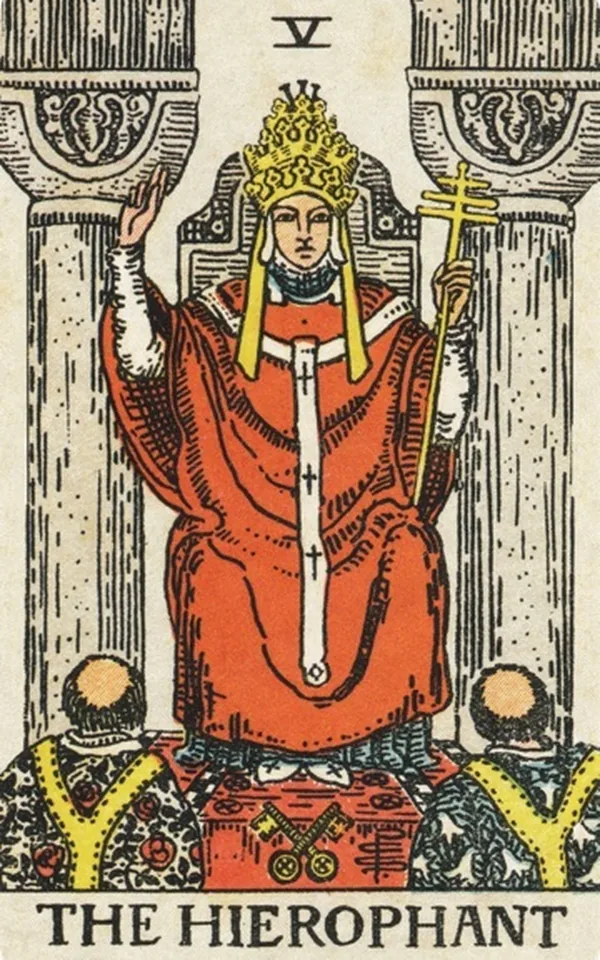
△ The Hierophant
The Hierophant
- tradition
- teaching
- institutions
- shared meaning
Quick facts
- Deck
- Major arcana
- Number
- No. V
- Artwork
- Rider-Waite-Smith · 1909
Upright
You do not have to invent everything from scratch. The Hierophant points to the accumulated wisdom of people who did this before you — the mentor, the manual, the tradition that survived for a reason. This is a good season to learn the rules properly before you bend any of them.
Reversed
Reversed, the tradition has outlived its reason — ceremony without meaning, hierarchy without service, or your own conformity masking doubt. It is permitted to keep the ritual and drop the dogma. Or leave the institution; the learning stays with you either way.
In love, at work, with money
In love
In love, The Hierophant favors the real conversation — meeting the families, defining the relationship, doing it in daylight. Traditions are tools here, not cages: use the rituals that genuinely fit you two, skip the ones inherited by default.
At work
At work, this card backs credentials, mentorship and institutions — the certification, the senior ally, the method the field already respects. Learn the rules of your guild properly; you cannot bend a system you never bothered to learn.
With money
Money-wise, The Hierophant is the boring, proven path: index funds, employer plans, the advice that has survived decades. Now is not the moment for financial inventions.
Common questions
Is The Hierophant a yes or no card?
Yes, by the book. The Hierophant says yes to the conventional route done properly — commitments, contracts and tradition — and asks you to check whether the convention still serves you.
What is the difference between The Hierophant and The Emperor?
The Emperor rules structures you can see — thrones, borders, schedules. The Hierophant rules the invisible ones — beliefs, rites and the shared story a group lives by.
Reads in combination
- The Tower — Hierophant + Tower: the doctrine cracks under what it cannot explain — build on evidence, not on homage.
Sources & further reading
Card art: the Rider-Waite-Smith tarot (1909) — public domain originals. Symbol readings follow the original deck's imagery; the meanings are Soulolo's own plain-language interpretations.
Ninety seconds is enough
Ask one honest question and take one small action. The paper updates every night.
Draw tonight's cards