Back to the deck · No. 20Cups
△ Six of Cups
Six of Cups
- nostalgia
- innocence
- old friends
- kindness returned
Quick facts
- Deck
- Cups
- Number
- No. 20
- Artwork
- Rider-Waite-Smith · 1909
Upright
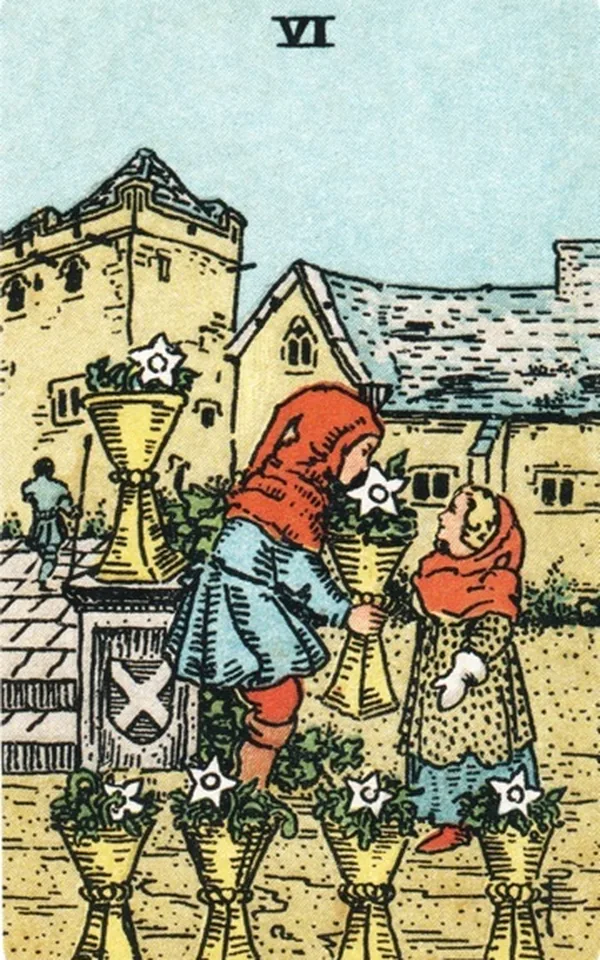
Children in a courtyard, one giving flowers to the other. Six of Cups is sweetness with history — the old friend who reappears, the kindness you can finally return, the childhood thing worth resurrecting as an adult. Give something simple to someone today; that is the whole assignment.
Reversed
Reversed, the past is leaking into the present: nostalgia used as an exit from today, or an old debt of kindness repaid with interest it never earned. Visit the memory; do not move into it. What was good then can be re-made newly now, not restored.
In love, at work, with money
In love
In love, the Six of Cups is sweetness with history: an old flame returning, or a present love that feels like childhood summer — safe, playful, kind. Nostalgia is welcome here as seasoning, not as a map. Give like a child: freely, without invoices.
At work
At work, this card favors mentorship and memory: the colleague who teaches you patiently, the craft you learned young. Give knowledge away — generosity with skill compounds strangely well.
With money
Money-wise, the Six of Cups is gifts and heritage: family support, an old asset maturing, kindness economics. Accept help gracefully; it is a cup being passed, not a debt.
Common questions
Is the Six of Cups a yes or no card?
A nostalgic yes — for reunions, gifts, family matters and gentle beginnings. The Six of Cups says the sweetness is real; just make sure the past is seasoning, not the recipe.
What does the Six of Cups symbolize?
Two children in an old village courtyard, one filling a cup with flowers for the other — innocence, memory and kindness exchanged without calculation.
Reads in combination
- Judgement — Six of Cups + Sun: memory in daylight — the reunion or revisiting goes warmly, without the ache.
Sources & further reading
Card art: the Rider-Waite-Smith tarot (1909) — public domain originals. Symbol readings follow the original deck's imagery; the meanings are Soulolo's own plain-language interpretations.
Ninety seconds is enough
Ask one honest question and take one small action. The paper updates every night.
Draw tonight's cards