Back to the deck · No. 22Cups
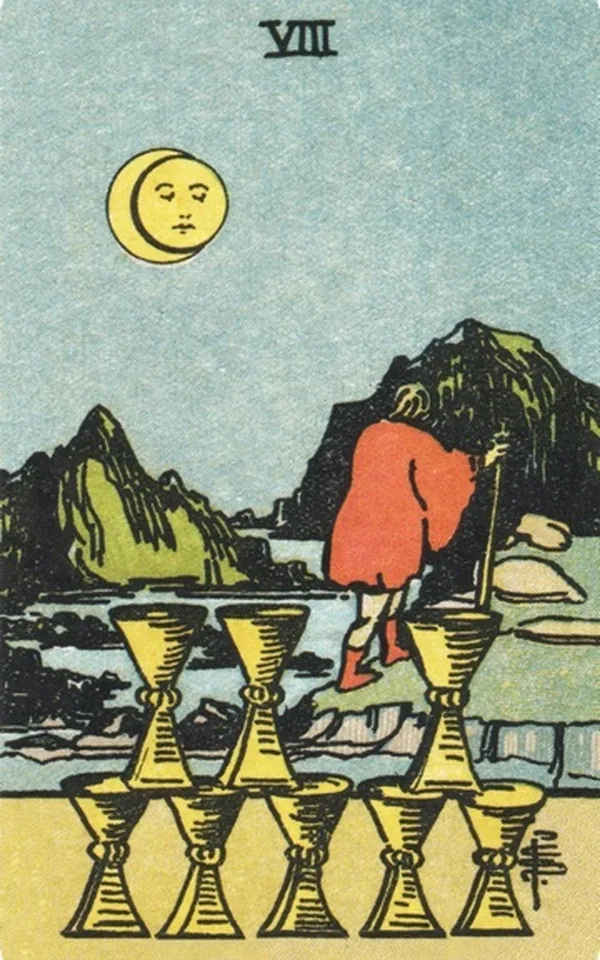
△ Eight of Cups
Eight of Cups
- walking away
- deeper meaning
- the good-enough left behind
- searching
Quick facts
- Deck
- Cups
- Number
- No. 22
- Artwork
- Rider-Waite-Smith · 1909
Upright
Eight full cups stand stacked, and the figure walks away at moonrise. Eight of Cups is the disciplined leaving: the thing is objectively fine and privately not enough. You are not ungrateful; you are honest. Leave the stack, take the staff, and let the search justify itself.
Reversed
Reversed, the leaving is stalling — one more reason to stay, or fear of the cold road dressed up as contentment. Test the contentment honestly: if it holds, stay warmly. If it leaks, you already know. Also check you are not leaving right after a victory out of restlessness.
In love, at work, with money
In love
In love, the Eight of Cups is the quiet walk-away: the relationship or the version of it that stopped feeding your soul, left behind not in anger but in honesty. You are not failing — you are refusing to pretend. Moonlight on the exit is permission enough.
At work
At work, this card marks the deliberate exit: the role you outgrew, the project that will never fill its own cups. Leaving before bitterness sets in is a skill. Pack what matters — the learning comes with you.
With money
Money-wise, the Eight of Cups is cutting the sunk cost: the investment, the subscription-life, the position that exists only because you started it. Walking away is a financial skill.
Common questions
Is the Eight of Cups a yes or no card?
A solemn no — to staying. The Eight of Cups says the deeper search matters more than the comfortable setup; the answer is yes only to walking on.
Why does the figure leave the cups behind?
Eight full cups stacked neatly — and still the figure climbs toward mountains under an eclipsed moon. Fullness without meaning is not fullness: that is the card's entire argument.
Reads in combination
- Death — Eight of Cups + Death: walking away and ending agree — this exit closes a chapter properly.
Sources & further reading
Card art: the Rider-Waite-Smith tarot (1909) — public domain originals. Symbol readings follow the original deck's imagery; the meanings are Soulolo's own plain-language interpretations.
Ninety seconds is enough
Ask one honest question and take one small action. The paper updates every night.
Draw tonight's cards