Back to the deck · No. XIIIMajor arcana
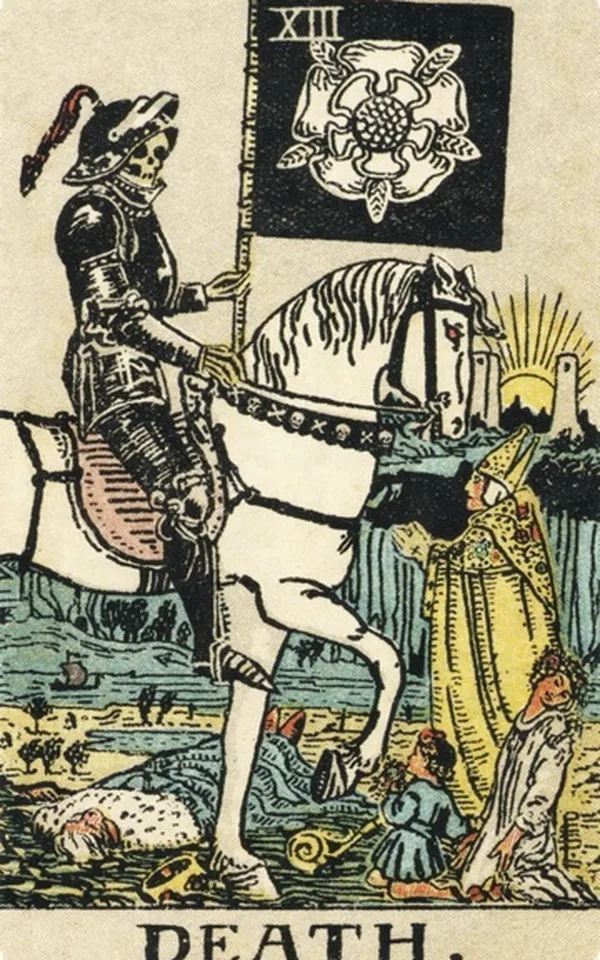
△ Death
Death
- ending
- transformation
- release
- transition
Quick facts
- Deck
- Major arcana
- Number
- No. XIII
- Artwork
- Rider-Waite-Smith · 1909
Upright
No, probably not literally. Death is the tarot's cleanest card: something is over, and the over-ness is the mercy. The branch pruned is the one that blooms. Stop resuscitating what has already finished — the job, the version of the plan, the argument — and let the space it leaves do its work.
Reversed
Reversed, you are gripping the ending shut: half-finished goodbyes, a door held open by one toe, fear of who you are on the other side. The transformation is patient but not infinite. Pick one thing this week to actually let finish.
In love, at work, with money
In love
In love, Death is the honest ending or the honest rebirth: the version of the relationship that no longer exists must be grieved so the next one can be real. Neither clinging nor rushing — a clean goodbye, or a love rebuilt on new terms.
At work
At work, this card closes a chapter: the role, the business model, the client relationship that has stopped feeding anyone. End it deliberately and the freed energy redeploys; drag it out and the corpse runs payroll.
With money
Money-wise, Death is cutting the recurring dead weight: the subscription, the position, the expense that survives on momentum alone. Clearing it out resets the whole budget's breathing.
Common questions
Does the Death card mean someone will die?
No — and any reader telling you that is guessing. In practice it marks endings and transformations: jobs, relationships, identities, chapters. The tarot does not predict deaths.
Why does the sun rise behind Death?
On the horizon, between the towers, dawn is already up. Every ending in this card is drawn with the next thing's light behind it — that is the deck's own commentary on endings.
Reads in combination
- The World — Death + World: an ending completes a whole chapter — close it with ceremony, not with a shrug.
Related terms
Sources & further reading
Card art: the Rider-Waite-Smith tarot (1909) — public domain originals. Symbol readings follow the original deck's imagery; the meanings are Soulolo's own plain-language interpretations.
Ninety seconds is enough
Ask one honest question and take one small action. The paper updates every night.
Draw tonight's cards