Back to the deck · No. 45Pentacles
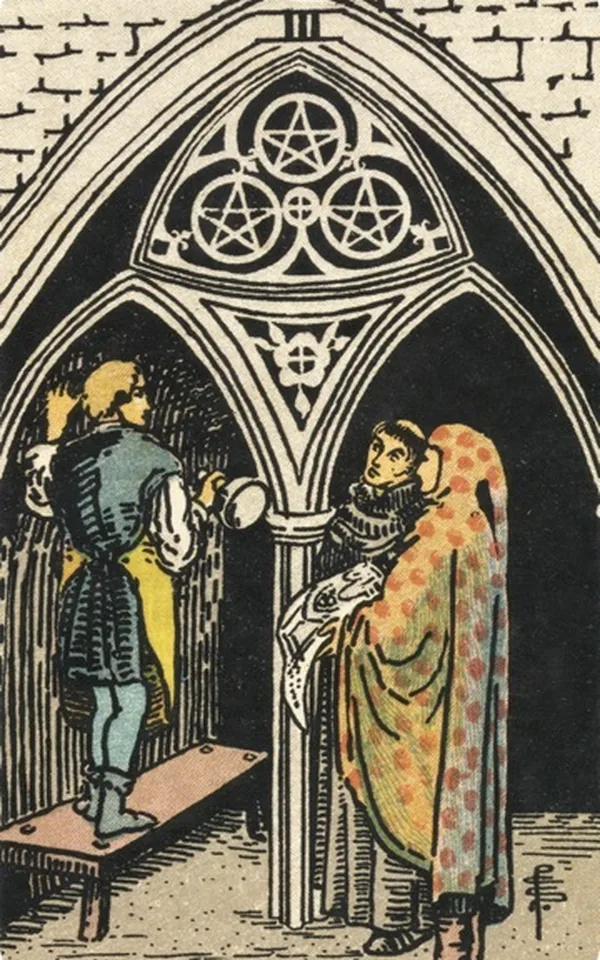
△ Three of Pentacles
Three of Pentacles
- collaboration
- craft recognized
- the built cathedral
- skill meeting plan
Quick facts
- Deck
- Pentacles
- Number
- No. 45
- Artwork
- Rider-Waite-Smith · 1909
Upright
A mason works; a monk and an architect hold the plans. Three of Pentacles is craft in collaboration — your skill, someone's blueprint, a shared build bigger than any single pair of hands. Show your work to the other two this week; the cathedral advances only when the trades actually talk.
Reversed
Reversed, the collaboration leaks: credit hoarded, meetings without blueprints, or craft withheld out of resentment. Re-establish the working agreement — who designs, who builds, who signs. Skilled people doing parallel solo work is not a team; it is three soloists with shared rent.
In love, at work, with money
In love
In love, the Three of Pentacles is the built-together life: the couple (and the helpers — friends, family) drafting the same blueprint. Appreciation flows to each person's craft. Say "thank you for your part" often; the cathedral rises on acknowledged work.
At work
At work, this is the mastery-team card: your skill recognized inside a shared build — the architect, the mason, the monk approving plans. Craft + cooperation is the formula; ask for feedback by name.
With money
Money-wise, the Three of Pentacles pays for competence: the raise justified by skill, the contract renewed on quality. Invest in your craft — it is the most liquid asset you own.
Common questions
Is the Three of Pentacles a yes or no card?
A craftsman's yes — for teamwork, skilled projects and anything built with others. The Three of Pentacles says the blueprint is good and the crew is right; build it together.
What does the Three of Pentacles symbolize?
A mason at work in a cathedral while a monk and an architect review plans — skill honored inside a shared structure. It is the card of teamwork that respects craft.
Reads in combination
- The Empress — Three of Pentacles + Empress: craft plus tending — the project grows because it is being fed by more than one pair of hands.
Sources & further reading
Card art: the Rider-Waite-Smith tarot (1909) — public domain originals. Symbol readings follow the original deck's imagery; the meanings are Soulolo's own plain-language interpretations.
Ninety seconds is enough
Ask one honest question and take one small action. The paper updates every night.
Draw tonight's cards