Back to the deck · No. 38Swords
△ Ten of Swords
Ten of Swords
- rock bottom
- the final straw
- over by definition
- dawn on the horizon
Quick facts
- Deck
- Swords
- Number
- No. 38
- Artwork
- Rider-Waite-Smith · 1909
Upright
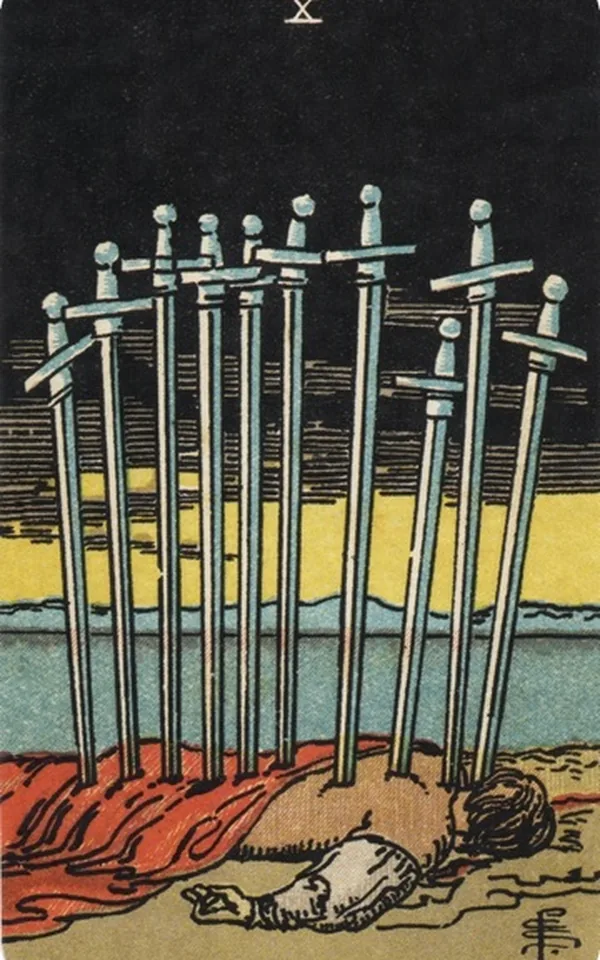
Ten swords, one back, and — look — a golden horizon. Ten of Swords is the ending that finished while you were still negotiating. The good news, structurally: it cannot get worse in this direction. Let the over be over. The horizon is not decoration; it is tomorrow, already scheduled.
Reversed
Reversed, recovery begins or the knives are being re-counted. If recovering: slow, unglamorous repair — eat, sleep, one small true step. If re-counting: it is over; relitigating the tenth sword is how tomorrow gets stolen too.
In love, at work, with money
In love
In love, the Ten of Swords is the absolute bottom: the ending that has fully ended. Painful — and strangely free. There is nowhere lower to fall, and dawn is already in the corner of the frame. Let the chapter be over; the next one does not repeat this plot.
At work
At work, this card is total collapse of the old plan: the role eliminated, the venture closed. Nothing left to fight for here — which is the gift. Take the lessons, accept the ending, and notice the sunrise already scheduled.
With money
Money-wise, the Ten of Swords is the financial rock bottom: the full loss on paper. Once you see the whole number, you can rebuild on fact instead of fear. The worst-case has been located — it ends here.
Common questions
Is the Ten of Swords a yes or no card?
A final no — to the thing as it was. The Ten of Swords ends a cycle completely; the only yes available is to the new beginning forming behind the horizon.
Why does the Ten of Swords show a sunrise?
Ten blades in a figure's back, black sky — and dawn breaking on the horizon. The deck's verdict on rock bottom: it is a location, not a residence, and morning comes with it.
Reads in combination
- The Fool — Ten of Swords + Fool: the bottom that is also a door — pack light; the next circle starts from zero.
Sources & further reading
Card art: the Rider-Waite-Smith tarot (1909) — public domain originals. Symbol readings follow the original deck's imagery; the meanings are Soulolo's own plain-language interpretations.
Ninety seconds is enough
Ask one honest question and take one small action. The paper updates every night.
Draw tonight's cards