Back to the deck · No. 42Swords
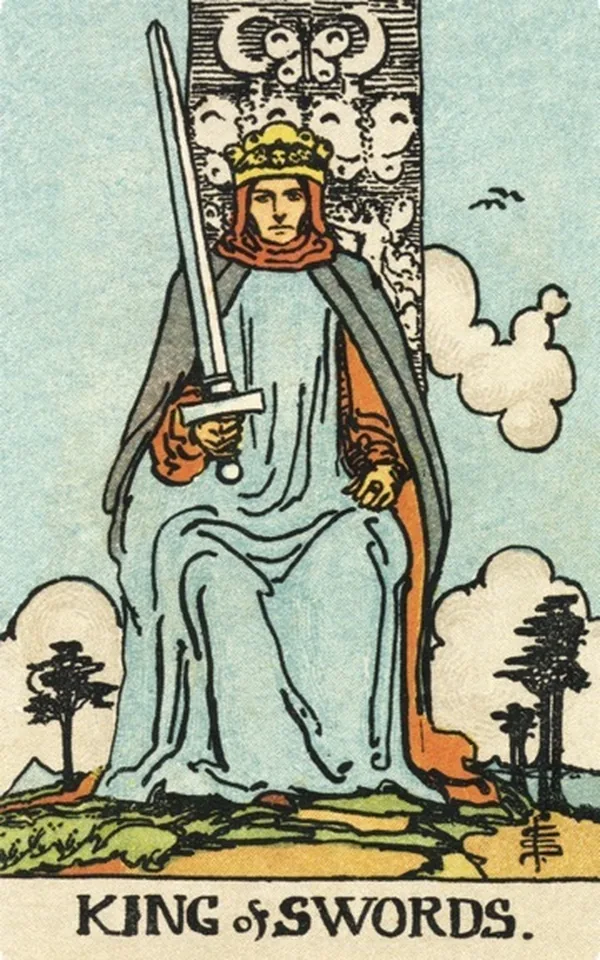
△ King of Swords
King of Swords
- authority of reason
- judgement
- ethics
- the clean verdict
Quick facts
- Deck
- Swords
- Number
- No. 42
- Artwork
- Rider-Waite-Smith · 1909
Upright
The King judges from the cloud throne: sword vertical, face level, no drama. King of Swords is authority earned by clarity — the ruling that everyone accepts because it was reasoned in the open. When the decision is yours to make, make it like him: criteria first, evidence second, sentiment a distant third.
Reversed
Reversed, reason becomes tyranny: rules without context, intellect used to win rather than to decide, or analysis as an elegant form of hiding. A verdict that ignores being human is technically correct and actually wrong. Re-include one human variable.
In love, at work, with money
In love
In love, the King of Swords loves with integrity: honest words, kept agreements, respect as a standing rule. Emotional logic works here — talk like adults, decide like partners. What he will not do is blur truth to keep peace; neither should you.
At work
At work, this is the authority of expertise: the judge, the strategist, the one whose analysis ends debates. Rule by reason and let ethics hold the sword. Your standard becomes the institution's standard.
With money
Money-wise, the King of Swords is principled finance: contracts honored, terms understood, nothing signed in fog. Decisions from doctrine and data — emotion stays outside the signature line.
Common questions
Is the King of Swords a yes or no card?
A principled yes — with conditions in writing. The King of Swords says yes to what aligns with truth and ethics; expect terms, and give your word carefully.
What does the King of Swords symbolize?
A crowned judge on a stone throne, blade upright — intellect crowned with ethics. He rules the kingdom of clear thought: law, strategy, and the word that means what it says.
Reads in combination
- The Hanged Man — King of Swords + Justice: reason and scales — the ruling that holds because it was reasoned, not felt.
Sources & further reading
Card art: the Rider-Waite-Smith tarot (1909) — public domain originals. Symbol readings follow the original deck's imagery; the meanings are Soulolo's own plain-language interpretations.
Ninety seconds is enough
Ask one honest question and take one small action. The paper updates every night.
Draw tonight's cards